It had been a couple of years since I went to the Newport wetlands, but a friend's tale of a booming bittern drew me there, never having heard one. I hoped I might pick up a few snaps of some of the other residents too, although it's never been the easiest place to get good views.
I did catch a reed bunting with a nice black head rather than the half moulted phase I normally seem to catch.
The Cetti's warblers remained as frustrating as usual however.
Wandering over the pontoon bridge I bumped into a pair of hydrophobic swans, which were winding up a somewhat confused territorial male .............
and while I was grabbing a quick snap or two the sound of someone blowing over the top of a bottle seeped into my consciousness. After a few seconds it clicked! I heard the bittern a few more times that morning, but wasn't surprised not to see it.
A week or two later I wandered down to the estate lake to make sure the grebes hadn't bred behind my back - no sign, but a sedge warbler was singing away from various decaying reedmace heads - these probably being my favourite views.
Showing posts with label Newport wetlands. Show all posts
Thursday, June 02, 2016
Monday, July 11, 2011
Orchid bees and bee orchids
I'm acutely aware that I haven't posted much recently. Partly that's because life has been quite busy, partly because the dog means I'm not out with my 'real' camera so much (but lots of snaps with the pocket camera to come) and partly because I have a new project on the go - quite a lot of effort for not too much return so far, but like all such projects I live in hope! Certainly there will be some pictures to come in time.
Anyway I did take some flower snaps the other weekend. I'm no orchid expert, and I'm always taken aback by the variety of form individual orchid types can take, but I think these are all common spotted orchids despite the varying flower heads.


Some were growing in a local meadow (not Rich's this time, but Paul's), along with yellow rattle - the grass parasite that helps control the more rampant grasses that might otherwise swamp the flowers - ........
and this vetch - I think birdsfoot trefoil, but there were no seed heads to enable confirmation.
Over at Newport wetlands I found a vetch I recognised instantly - even though I had never seen it before - the grass vetchling. I first heard of it when Rich and Nic told me that they had found a specimen in their developing hay meadow. It's just as Nic described - typical pea flowers on the stems and leaves of a grass. Nice plant but tricky to photograph - tall and slim it's mostly fresh air!

The real aim of going to the wetlands was to see if 2011 was a better year for one of my real favourites - the last 2 hadn't been so good. Whilst snapping the grass vetchling a soft pink caught my eye, and sure enough it was my first bee-orchid for 3 years. With a bit more looking I found more, and eventually some I could snap with a more uncluttered background. Aren't these flowers just the bee's-knees! (Sorry).


I really do love them. Again they can be tricky to snap given the relatively narrow plane of focus macro lenses often have. Front to back it's a lot of flower to get sharp.
Larger pic's and a few more will appear on the web albums over the next few days, so do have a look.
Anyway I did take some flower snaps the other weekend. I'm no orchid expert, and I'm always taken aback by the variety of form individual orchid types can take, but I think these are all common spotted orchids despite the varying flower heads.


Some were growing in a local meadow (not Rich's this time, but Paul's), along with yellow rattle - the grass parasite that helps control the more rampant grasses that might otherwise swamp the flowers - ........
and this vetch - I think birdsfoot trefoil, but there were no seed heads to enable confirmation.
Over at Newport wetlands I found a vetch I recognised instantly - even though I had never seen it before - the grass vetchling. I first heard of it when Rich and Nic told me that they had found a specimen in their developing hay meadow. It's just as Nic described - typical pea flowers on the stems and leaves of a grass. Nice plant but tricky to photograph - tall and slim it's mostly fresh air!
The real aim of going to the wetlands was to see if 2011 was a better year for one of my real favourites - the last 2 hadn't been so good. Whilst snapping the grass vetchling a soft pink caught my eye, and sure enough it was my first bee-orchid for 3 years. With a bit more looking I found more, and eventually some I could snap with a more uncluttered background. Aren't these flowers just the bee's-knees! (Sorry).

I really do love them. Again they can be tricky to snap given the relatively narrow plane of focus macro lenses often have. Front to back it's a lot of flower to get sharp.Larger pic's and a few more will appear on the web albums over the next few days, so do have a look.
Tuesday, June 29, 2010
Worts and all
I couldn't resist a trip back to check on my flycatcher family. The good news was that the adults were actively hunting, and clearly feeding chicks. Sadly the nest hadn't transformed into a good site for photography, and the one or two pictures that were even vaguely usable at low resolution didn't show any insects.
A new perch was in use, and more user friendly for snaps. I won't see the family again now, but hopefully all will go well for them. Judging by the vuvuzela hum of insects in the background there should be plenty of food. (I think I nearly mentioned the world cup there - sorry!).


Nearer home I had to look twice at this bird before realising it was a juvenile bullfinch. A first for me.


A new perch was in use, and more user friendly for snaps. I won't see the family again now, but hopefully all will go well for them. Judging by the vuvuzela hum of insects in the background there should be plenty of food. (I think I nearly mentioned the world cup there - sorry!).
One surprise near the flycatchers was what I'm believe is a golden-ringed dragonfly. In my minds eye I had never pictured this as a Forest of Dean species - always thought more of upland areas.
and in the garden a mullein moth caterpillar had decided to leave the mulleins (verbascum) alone, and was tucking into this figwort (balm leaved?) - not a mullein, but same family - Scrophulariaceae, which sounds more like a disease than anything.
A local woodland hosted centaury
and, I think, hairy St John's wort (happy to be corrected on that one, but it seems the best fit - just not over hairy).
Southern Marsh orchid ....
and pyramidal orchid at Newport wetlands - no sign of any bee orchids. Don't know if I'd missed them or they just hadn't shown up this year.
Also at the wetlands self-heal.
And last but not least back to that local meadow (thanks Paul) for a lovely example of a common spotted orchid.
Labels:
Birds,
Flowers,
Forest of Dean,
Insects,
Monmouthshire,
Newport wetlands,
Plants
Wednesday, July 08, 2009
In the Doldrums?
It's coming to that time of year when the birds go, relatively, quiet. Birders' blogs start to show butterflies, moths and dragons and damsels (got to have pictures of things you can name!).
At the wetlands there really wasn't much to photograph, although I was pleased to watch a too distant flock of 7-8 bearded tits flying past. This little reed warbler was the only thing to pose in range, nestling beside the 'bearskins' of the reedmace. Even that didn't stay long.

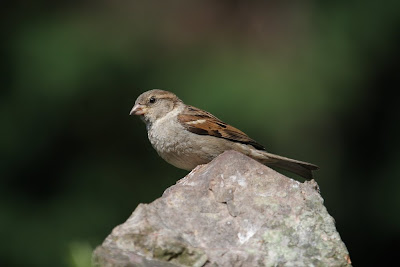
In the garden the sparrows showed well. Looking at the beak I guess this is a juvenile, with a hint of 'gape' remaining - compare it to the third picture. the wall next to the bird table is a good spot to catch birds against the conifers over the road - nice to know the blasted things serve some purpose. The collared doves weren't too shy, but sadly the jackdaws wouldn't play ball. I'd wanted to snap one of the juveniles. Maybe I need to leave the hide up so they get used to it . 


I did manage to snap one of the rare Monmouthshire crested blackbirds, though.

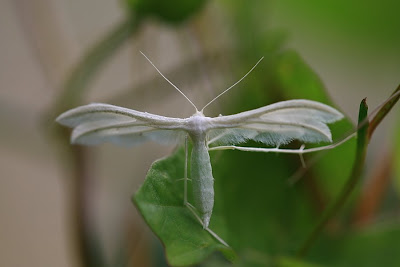
The white plume moth was posing again, this time from the other side, and I couldn't resist the greenbottle. I find it strangely intriguing. As with all the pictures, especially the insects, it looks better on the web album - click the link HERE and go to latest pictures.

I'm pretty sure this is a common green capsid bug....
but I'm struggling with these next two. The first had a white heart shaped pattern on it's 'face'.

If you know what they are, please leave a comment.
At the wetlands there really wasn't much to photograph, although I was pleased to watch a too distant flock of 7-8 bearded tits flying past. This little reed warbler was the only thing to pose in range, nestling beside the 'bearskins' of the reedmace. Even that didn't stay long.
The white plume moth was posing again, this time from the other side, and I couldn't resist the greenbottle. I find it strangely intriguing. As with all the pictures, especially the insects, it looks better on the web album - click the link HERE and go to latest pictures.
Wednesday, June 17, 2009
Like geese in clover ....
Another weekend on call meant the Forest was out of bounds, so it was back to the wetlands, not least in the hope of finding the little owl being mentioned in recent posts.
Some have grumbled about the RSPB presence and the impact of the visitor centre, complete with kids play area. I certainly feel it's bad they no longer sell bacon butties. Bird-wise though an early visit produced the owl - perched on top of one of the rides in the play area. Well I suppose it is a little owl.
The canada goose family were also at the centre, making the most of the daisy/clover lawn area,
and when I was leaving had wandered into the wildflower grassland. 
I kind of like these shots. Peaceful.
Meanwhile the owl had moved to scowl from another perch.
Out at the lagoons a swan was enjoying the weather,

a reed warbler was too busy to pose properly,
but the recently reliable sedge warbler
and a whitethroat caught the sun nicely.
A rabbit came quite close to have a look while I was sitting patiently waiting for the whitethroat, although eventually it seemed to cotton on, thumped it's hind leg and nipped back into the brambles.
Back home a froghopper led to the macro lens getting an airing
so I picked up the mullein moth caterpillar munching on a mullein (verbascum) that had seeded from somewhere. Intriguingly there is a type of verbascum called a moth mullein, as well as a moth called a mullein moth.
At the pond was a large red damselfly, 
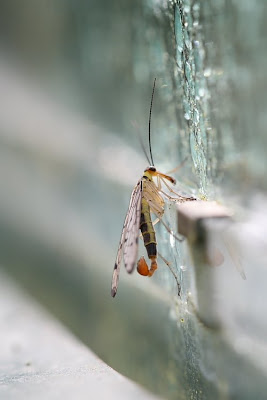
and I've dug out a tweaked shot of a pond skater and a scorpion fly I took some weeks ago. the scorpion fly pic is fairly rubbish, but it's the first shot I've got of a male with a proper 'sting'.

As I said last post - it's a lovely time of year. Check the 'latest pictures' album for better quality shots HERE
Some have grumbled about the RSPB presence and the impact of the visitor centre, complete with kids play area. I certainly feel it's bad they no longer sell bacon butties. Bird-wise though an early visit produced the owl - perched on top of one of the rides in the play area. Well I suppose it is a little owl.
The canada goose family were also at the centre, making the most of the daisy/clover lawn area,
Meanwhile the owl had moved to scowl from another perch.
Out at the lagoons a swan was enjoying the weather,
a reed warbler was too busy to pose properly,
but the recently reliable sedge warbler
and a whitethroat caught the sun nicely.
A rabbit came quite close to have a look while I was sitting patiently waiting for the whitethroat, although eventually it seemed to cotton on, thumped it's hind leg and nipped back into the brambles.
Back home a froghopper led to the macro lens getting an airing
so I picked up the mullein moth caterpillar munching on a mullein (verbascum) that had seeded from somewhere. Intriguingly there is a type of verbascum called a moth mullein, as well as a moth called a mullein moth.
Subscribe to:
Posts (Atom)