Monday, January 29, 2007

Big Garden Birdwatch

Another year, another big garden birdwatch, the annual RSPB survey of garden birds. For those who don't know participants watch their garden for 1 hour and count the maximum number of each species that can be seen at any one time. Last year 470,000 people took part.
I have done this for the last 4 or 5 years, although I've never bothered to keep a record of what I saw in past years, so I'm not sure exactly how this year compares. I know the 10 house sparrows this year was a record, and hopefully this is due at least in part to our own breeding birds (see my very first post).

Blue tits were second at 5 and again this is, I'm sure, an improvement. Also reassuring to see greenfinch still there despite the trichomoniasis outbreaks last year, although I'm sure 4 is down on past years. For me the highlight was our blackcaps - I'm getting nearer some decent pic's, especially of the male who has taken up residence in a euphorbia, but so far they've largely been shots though the window which isn't great (even though it did prompt me to clean the windows!)


Meanwhile a trip back to seek hawfinch proved unsuccessful, although I did get my best ever scope views of a green woodpecker - albeit to brief to get any snaps.
It was good to see the first signs of new growth in the woods with cuckoo pint shoots emerging, including a few of the spotted brand.

Also delighted that my new fungi book allowed me to name these colourful little chaps as scarlet elfcups. What evocative names some of these things have (even if a little cutesy).

Tuesday, January 23, 2007

Groundbreaking Fungi

In the Q&A section of the January BBC Wildlife magazine there is a piece about the 'power' different fungi can exert when the fruiting bodies are developing. They take up water which enables amazing pressures to develop. Mushrooms can generate 10lbs per square inch. The common stinkhorn can expand rapidly and can lift over 100 kg (that's what it says). In 1991 a potato earthball pushed its way onto a tennis court through a layer of fly ash, 75mm of packed gravel and 20mm of rolled tarmac. And I bet some spotty herbert came along and kicked it away before it ripened!

Got me thinking about fungi again. I now have a book (see previous post!) and so I went back over some of the snaps from last autumn to see what I had. It's not so easy retrospectively, as they do tend to look a bit like each other, and you can't look underneath a picture to check the colour of the gills!
A few were interesting though:
I had some snaps of earthballs, although theses weren't lifting paving slabs.

The hoof fungus has different forms according to it's host. No doubting that this one blends in with the birch it is growing on.

This is a Lycoperdon species - better known as a puffball. They were a bit soggy, so the spores weren't so much exploding out as sort of slopping. The childish part of my humour was tickled last year when someone on a tv programme pointed out that the latin name translates as 'wolf's fart'.

And it turned out that my oddity under a pine tree at work was a wood cauliflower (not the easiest thing to photograph).

About 10" across some spotty herbert had kicked it over, but it was still impressive. Mind you my book says they can be up to 14kg in weight! Although the distribution is described as 'widespread throughout temperate N. Europe' it also says they are 'rare', which makes me feel chuffed for some reason (it's not as though I tracked it, waited patiently in a hide or anything- it was just there when I escaped for some fresh air). It's just nice to collect something unusual.

Wednesday, January 17, 2007

Surely not?

The promise of a dry day prompted me to head for the Forest of Dean again. I tried Woorgeens Lake for the first time, in the hope of finding some lesser redpoll or goosander. Wading along the rivers of mud that passed for paths - thank God I bought some wellies - I reached the Lake and was aware of a strange sensation affecting my eyes. Dredging back through my memory I realised with a start what it was. I was squinting because the SUN was shining. There were SHADOWS on the ground and the sky was visible and BLUE. And it felt good.


Other than the swans there were nine goosander and a kingfisher, but all out of range. No redpoll yet though. Back at the car I had some more good views of a nuthatch, but I think we've had enough pictures of them by now.

A tip from a local birder took me to the Church at Parkend.


Looking over the rather quaint graveyard, scanning the tops of the hornbeams (with a little help from a couple of very friendly GOS members) I found them. Sadly a long way off, and out of digiscoping range, but there was no doubting that bull neck and huge bill. Half a dozen Hawfinch - one of my target birds for this year.

I did get some reasonable views last year, given how shy they are, but these shots are heavily cropped and not the frame fillers I want this time.


(Did you notice the brambling peeking over the horizon? That's another I'm after in 2007.)

Three things you didn't know about hawfinch (unless you also have Birds Britannica)

  1. The nominate race, scientific name is the longest for any British bird - Coccothraustes coccothraustes coccothraustes
  2. Its ability to crack cherry stones with that stunning bill means that it is is delivering a pressure more than a thousand times its own weight - a load of up to 95 lbs. The equivalent force in a human would be more than 60 ton(ne)s.
  3. They eat peas

The good news is I think I know where they might be ground feeding and there was loads of cover, so maybe, just maybe, I'll snap them.

Sunday, January 07, 2007

Bedroom Predators

Well OK not so much predators in the bedroom as from it. Or to be more specific raptors. I have to admit that this first shot is pretty desperate but it is a handheld digiscoped snap at maximum magnification through double glazing, and the only chance I had before the buzzard flew. This pole is quite often used by our local buzzards, but I've included this shot only because it is (sadly) the only real shot I have yet of our local 'pale form' bird. The head was mainly white, and at first glance it looked more like an osprey. In fact until it turned to show the wings the whole bird looked white. I've seen it around a few times, so hopefully will eventually get a better shot, but they are a pretty shy and have excellent eyesight!

Shortly afterwards I looked out again to see another of our recent regulars.


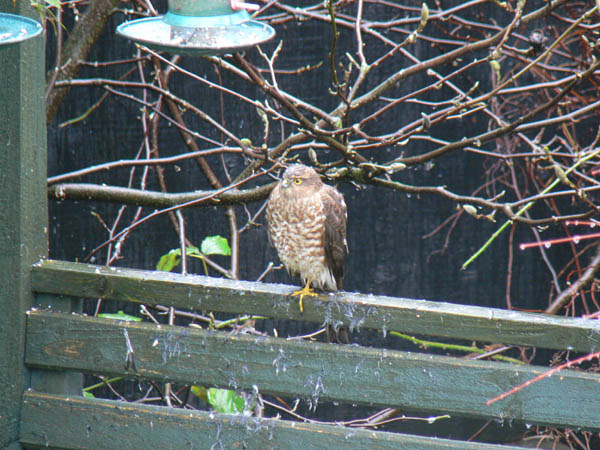
Don't you just love those eyes! I presume this is a young male sparrowhawk - he has the brown barred breast, but not the grey head yet. We see him on this bench at least once a day. If you look at his feet you will see that he has also used this as an eating perch, although neither Kay nor I have seen him dining yet.

The next shot shows why he comes.


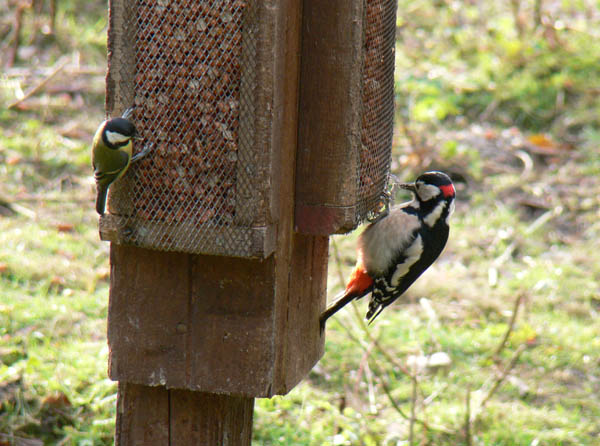
The bench is under one of our feeding stations, but he never seems to be actively hunting when sitting there. Even the local blue tits do still move around in nearby trees ...... then again I guess that is just what he is looking for!

Still seeing the male blackcap and a few glimpses of a female, but if we don't get some proper bloody daylight soon (well more than the hour or so we've had in the last week) I don't think I'll ever get any decent photos!

Thursday, December 28, 2006

Little things can brighten the day

What god-awful weather we had around Christmas. OK it was dry and not too cold for time of year, but someone had sucked all the light away. Taking photos was something of a lottery, but just about managed a shot (let's call it a record shot - i.e. a bit rubbish) of our recently arrived male blackcap in the garden,


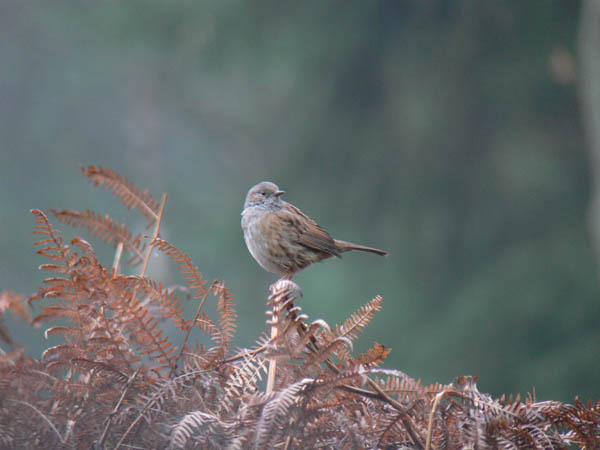
a dunnock and another nuthatch in the Forest of Dean (this time without the bottle top)


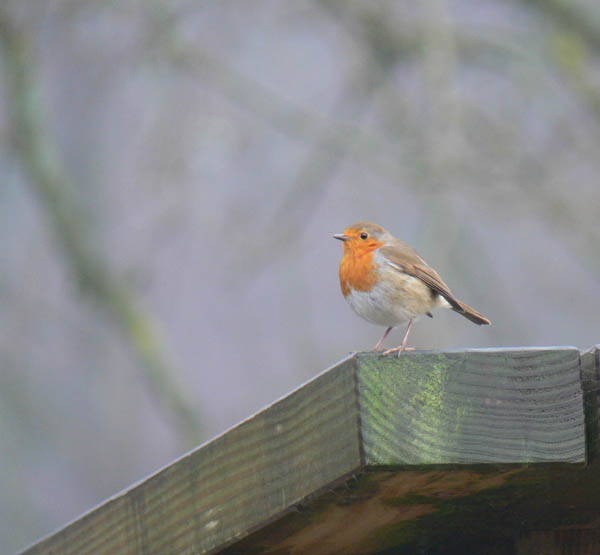
and yet another robin on a picnic table (well ........ it's Christmas. Did you know robins were reputedly associated with Christmas because postmen wore red coats at the time Christmas cards took off commercially in the 1860's? Birds Britannica - can I plug that book again - has other suggestions, including the fact that the robin has such a conspicuous winter song at a time when there is such little competition)

Monday, December 25, 2006

Christmas came early ......

One of the advantages of visiting the in-laws (there are other less selfish ones too), is the fact that I can leave Kay with her mum doing things and have a few guilt free hours nature watching. Just before Christmas I grabbed the chance to go back to Potteric Carr Nature reserve while they were 'doing' the Lakeside Outlet Centre!

A dull day was lightened when the warden told me a water rail had been showing at a feeding station near one of the hides, so I went and camped there for a couple of hours.

First visits were from the usual suspects

but then the first of the new birds for me appeared


After some discussion it was agreed this was probably a female golden pheasant, and a look at my books would seem to confirm this. Far from the right habitat though.

Then the moment I had been waiting for


I have heard the squealing cry of water rails many times at Newport Wetlands, but this was my first clear view. Although shy it did eventually venture out into the open a bit more.


Sad though I was to miss the chance of leafing through M&S leftovers (!) the visit had been a good choice. However there was another bird they told me was around which left me wanting more.

But that can wait .............

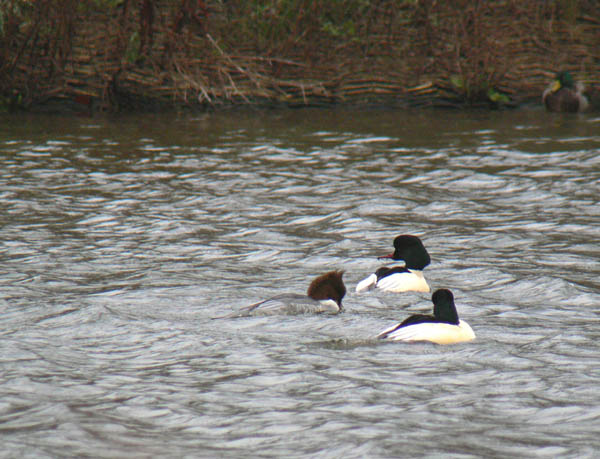
Walking the dog at Clumber Park provided some fair views of shy goosanders


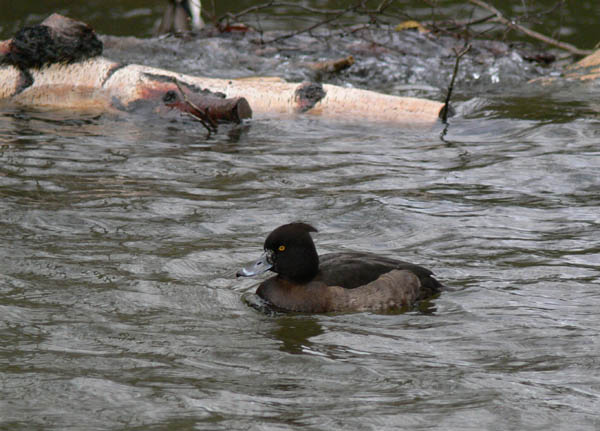
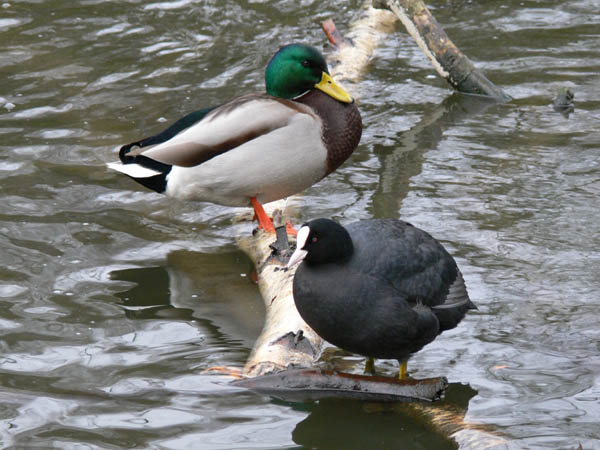
and better ones of the local ducks. In my experience to date a close contact with tufted duck is rare, so it was pleasing to get this shot, whilst the mallard and coot were just sort of cute.


In the light of what I had been told at Potteric Carr I persuaded Kay our journey home could be postponed until later in the day giving me chance to return to try my luck.

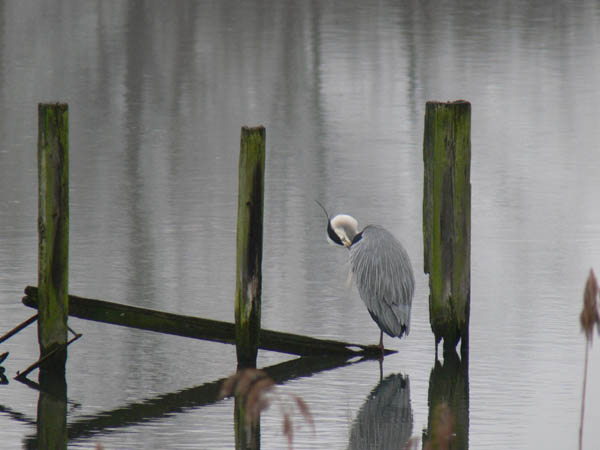
Initially the herons in view were all of the standard grey variety.....


but then I went into a hide to find a guy gesticulating furiously for me to be quiet and move slowly. It took me a liitle while to spot the target of my return visit, demonstrating the reason for the bird's plumage and behaviour - even though it is centre of the frame you might find youself doing a double take before you pick it out. If you still don't get it click on the picture for a larger version.


But there was no doubt - a sky pointing bittern just a few yards away. I then had the pleasure of watching it for about half an hour, even fishing, sliding it's beak through the reed stems in a quite creepy way, although I didn't see it catch anything. Brilliant - a bog bumper at last. You can click on the photos if you want to see slightly larger versions.


Thursday, December 21, 2006

Donna Nook Seal Rookery

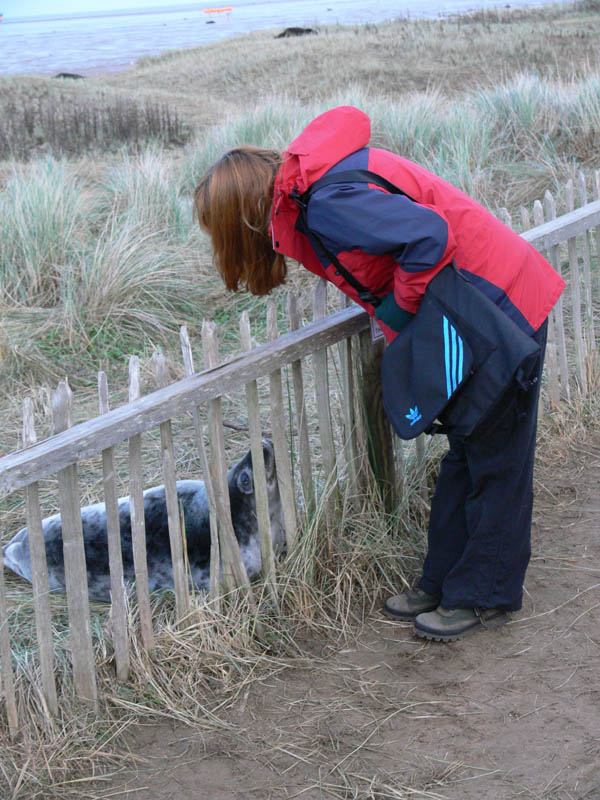
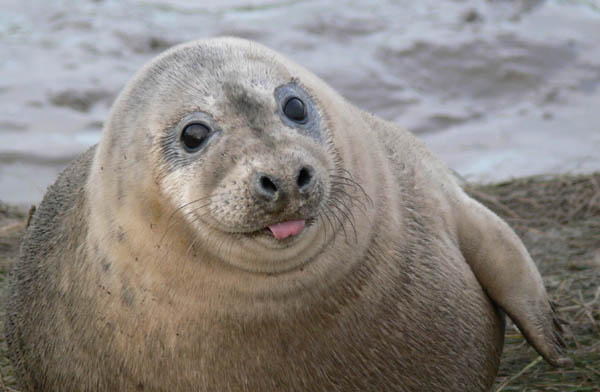
Anyone who watched what I thought was a great little TV series - 'Nature's Calendar' - will have seen the grey seal breeding site at Donna Nook on the North east Lincs coast. It looked too good to be true, but being in the area (well nearly) kay and I decided to have a look. It wasn't the best of days weather-wise, but the site was amazing. I'll let the pictures speak for themselves.


One of the first pups we saw was this one - obviously fairly new to the world, but, slightly worryingly, by itself.

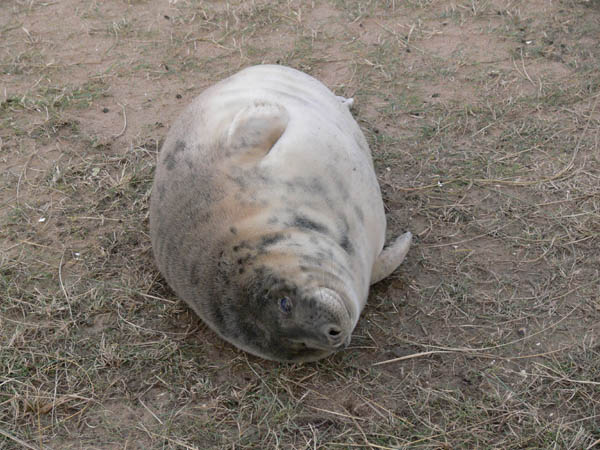
Older pups had assumed what could only be described as football shapes, and were more than happy to watch passing visitors. (I should point out that the Adidas bag is not what Kay has to use as a handbag, but is what I carry my camera kit in!). They are only suckled for 2-3 weeks, then abandoned to get on with it - eventually hunger will drive them down to the sea. Their growth rate is phenomenal - a newborn doubles it's weight in the first week, and loses the white coat a couple of weeks later

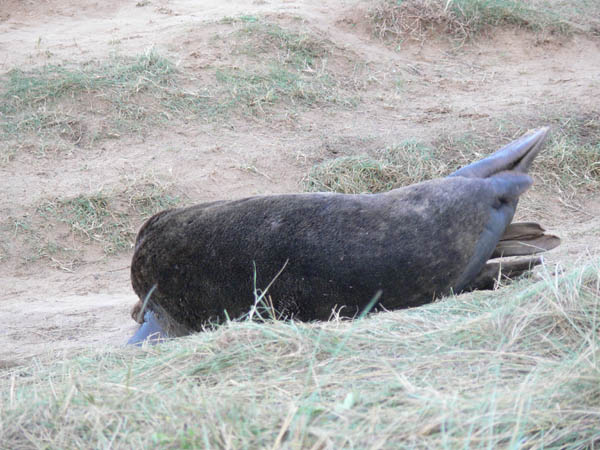
The adult males were more sparse on the ground, but quite intimidating, reaching 230kg in weight, 2 metres in length.

Perhaps not the clearest picture but this is seal pornography with next years pup being conceived. Try not to stare! Often takes place in shallow water, but also does occur on the beach.

Sadly, but inevitably, not all the pups made it, and we saw this one being eyed up by a Lincolnshire pied vulture.

It got us a bit worried again about the little newborn, but fortunately by the time we got back to it a mother had appeared and it had resumed it's quest to become a football.

When we were at Donna Nook the 1,000th pup of the year had been born, giving an idea of the numbers involved at this fabulous site owned by the MOD (they stop bombing practice in the breeding season), and run by The Lincolnshire Trust. If you get the chance to go in Novemeber or December take it - you will not be disappointed.

PS It is not all rosy for Britain's 110,000 grey seals. BBC Wildlife magazine (December) reports that about 5,000 are thought to be culled by fishermen each year. Legal restrictions still allow seals in the vicinity of fishing gear to be shot. There is no requirement for evidence of damage, and vicinity is not defined. Five grey seals, 4 pregnant females were recently shot dead at Point of Vastray in Orkney.

Thursday, November 30, 2006

Nut Warblers and a scaly legged finch

Forecasts for another dry, if not sunny day saw an early(ish) start at the weekend. My quest for the day was a return to the Cyril Hart arboretum in the Forest of Dean to see whether I could get any shots of the Nut Warblers (Delor y cnau), or nuthaks as Chaucer might have had it.

I had noted last week that they would come down to seed on the ground, but they would tend to grab a single peanut and shoot off. Instead I took some environmentally friendly 'won't grow' seed in the hope they might hang around a while longer.

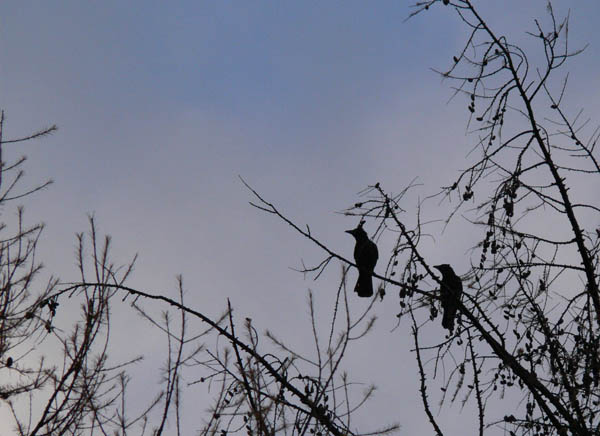
Another misty morning welcomed by a pair of crows, and I started to worry about the light levels. This wasn't going to be easy!


I started off tucked back under the trees, using the telescope to try and get a decent frame filling digiscoped shot. The excellent sensor on the fuji 30 allowed pictures at low light levels, but focusing proved tricky, and there was some definite purple fringing.

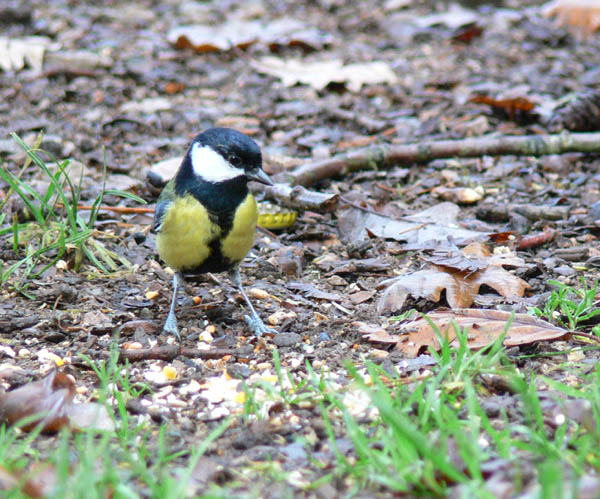
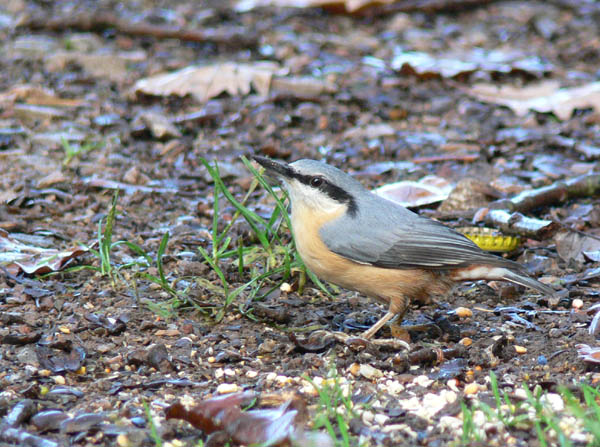
I decided to see how brave the birds were and was amazed to find I could get within a few yards and the birds would still feed. Admittedly I was tucked up in my coat under a hood, but even so their tolerance was a surprise - such a surprise that I didn't take in the bottle top that unfortunately inhabits some of the shots! Even more surprising was the number of people walking past who only seemed to notice me at the last minute, ofetn as they were standing on the seed!


Great Tit

Coal tit

Nuthatch


The seed worked well, with the nuthatches pausing to pick up several sunflower seeds most times - helpful given the fact that they tend to move so fast and the light was still pretty poor.

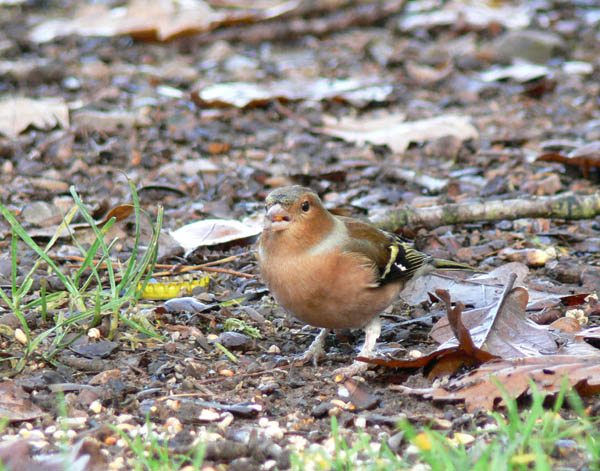
Ended up with a couple of shots I was happy with, including the scaly legged chaffinch - I believe this is due to a mite infestation. It looked bad, but the bird itself seemed fairly healthy otherwise.

Chaffinches - female top, scaly legged male below