Wednesday, July 23, 2008

Best of the rest July

Every so often I get a build up of pictures that I'd like to post, but for one reason or another haven't fitted into the blog. For me that often means wildlife other than birds. So here are a few recent examples (starting with some birds, just to be contrary!)
Swallow (Durdle Door campsite) - shot with a macro lens!

Whitethroat with twigs (Uskmouth) - I was torn here because there were a few family groups flitting around, but I wasn't getting clear shots and decided to head for the bearded tits again

Sedge warbler (Uskmouth)


Fallow deer (Arne)

Meadow brown (Durdle Door) - the week's only butterfly that braved the winds!

OK from hereon in they're flowers, so if that's not your bag farewell! You have to love the names though. All from Dorset - either Durdle Door or Radipole. Remember flowers are my second most guessed at identifications (after fungi), so if they're wrong just let me know.


Viper's Bugloss

Common Toadflax

Purple Loosestrife


Burdock (Lesser?)

Marsh woundwort
Comfrey

Meadowsweet
Common mallow

Orchid at Radipole - the flowers look like pyramidal, but never seen such a big head, so really not 100% sure. The guides say pyramidal and southern marsh grow at Radipole, and it's not the latter.

And finally this little plant growing on the downs at Durdle Door really has me stumped - just can't work it out from my books - so if you know please post a comment
As always better quality versions of the photos will be added to the web gallery
- see link

Wednesday, July 16, 2008

Anything Dorset can do ...................

After Radipole I was again tempted to Uskmouth where the beardies seem to have been more in evidence this year - or perhaps I'm just tuned into the calls better.

A reed bunting was working it's way through an elder bush ....

and just for a second I thought there was something unusual in sight, until the profile changed and revealed the classical robin shape. Then again ...... Lewis Thomson (see comments and links to right) has kindly pointed out this is actually a juvenile stonechat, so it was somewhat unusual after all!

But there was more success on the beardie front. As well as the quite frequent pinging, I had another reasonable view of two juveniles although I was disappointed with the clarity of the shots. No wind and reasonable sunshine, but they do tend to bounce around a bit .....


and fly off.
Brilliant to find the evidence of breeding locally.
As always better views via the photo gallery link, in the 'latest' album.

Dorset 2 - Some tell tales of bearded babies .........

In contrast to the relative isolation of the wild and windswept heaths, there is an RSPB reserve right in the middle of Weymouth - Radipole Lake. I managed to wangle couple of hours there on a day where there was some sun (and wind). A local was enjoying the chance to sunbathe on a special RSPB bathing terrace .........

whilst another watched the world go by until it's feathers grew.

A female ruddy duck came for a look, but sadly no male and no sign of the hooded merganser seen recently.

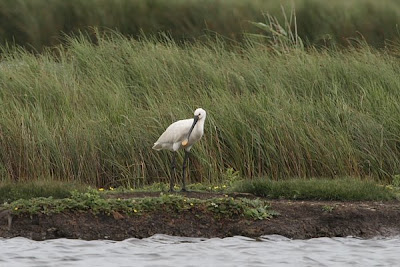
Unfortunately, half of the reserve was off limits due to flooding (told you it was wet!) and there was no sign of the hoped for bearded tits. Still a nice RSPB man tipped the wink about Lodmoor reserve just up the road and Kay and I called in to see a spoonbill (why are they always next to the far bank?), some black tailed godwits (ditto), and a small flock of beardies, of which two youngsters came in camera range - albeit briefly. Some birds just don't know how to pose properly.

Still, a pretty good day out. As ever, better quality views in my 'latest' album via the web albums link.

Tuesday, July 15, 2008

Dorset 1 - Gone with the Wind

I suppose in some ways my interest in Dorset wildlife began with Aidan Brown's 'A Dorset Diary' blog on surfbirds http://www.surfbirds.com/blog/DD/ A good mix of birds, butterflies and flowers from a range of places with names like Arne, Middlebere, Hartland Moor, Morden Bog, to quote just a few recent examples. It's one I check regularly because it's not wildlife I see locally. So when we decided to have a short holiday down there I did a little research. The Dorset heaths are, apparently, home to hobbies (never had a good view), sand lizards (never seen), smooth snakes (ditto) and the almost mythical Dartford warbler. I'd have been happy to see one of this list. Let's face it for reptiles you really need a bit of sun (we had a few minutes here and there), and for the DW it was always going to be pot luck. The guide said they were skulking birds that flit from gorse bush to gorse bush, and DON'T LIKE WIND. The gales didn't let up for 5 days so you can guess the rest.

So you won't see any of the above. But don't despair, there are other more common heathland birds. As always click on the link to my 'latest' web album for better quality pictures. The wind did make clear shots a little tricky, but some worked out.

Stonechat.
Surprisingly hard to get near at Durdle Door where we were staying, but I eventually found a pair feeding young. The female was more accommodating.
A later visit to Arne produced better views of this male (clearer on the web album)

Linnet.
The most common with several family groups flitting around Durdle Door.

Yellowhammer.
A little shyer than I expected, but eventually some passable shots, again at Durdle Door.

Meadow pipit.
To my surprise, sitting next to a fence to try and get some linnet produced some good close views of this Mipit.

More Dorset to follow in a later post - I just bet you can't wait.

Friday, July 04, 2008

Being thankful for small mercies

Let's face it, July is not really prime birding time. And after a couple of days in the birdless wastes of central London (no, pigeons don't count in this context) I needed a bit of inspiration, and it came in the form of these pictures of juvenile bearded tits on Graham Catley's 'Pewit' blog : http://pewit.blogspot.com/2008/07/bearded-tit-juveniles.html
Why not, I thought, go and see if I can find any evidence of similar at Newport wetlands. After an hour or so the words birdless wastes started to reform in my mind, but I bravely cast them aside and snapped some easier targets.

Narrow leaved everlasting pea
Tufted vetch
Common melilot (and friend)
It turned out all was not lost on the bird front either. When I saw this reed warbler ...........
I knew there would be something else of interest - canny piece of detective work, eh? Always follow a full beak. Turned out to be a fledgling, which eventually showed, sort of.
In the magazines it would be sitting out on an isolated stem in all it's glory, but remember I live in the real world of limited time snapshots. Highlight was the one time I actually saw this food pass, rather than inferring it from all the shaking reed stems!
Having sated my birding needs just enough I headed for home, pausing to look in the ditches around the new visitor centre, where I saw two aquatic aliens. Huge great black things swimming along amongst the algae and weed. I know it's a rubbish picture (somewhat turd like?), but I have no doubt they were water beetle larvae. They look more like great silver in the pictures in my book, but this is said to be rare and so odds are they would be great diving, which is what I originally assumed. Must ask next time at the centre.


Oh, and just a few glimpses of pinging beardies, no obvious juveniles.

As always better quality pictures on the web album - follow link to right.