Thursday, June 07, 2007

Aviemore: Upland and Moorland

If the Aviemore area is famous for the remnant Caledonian Forest, it's actually the mountains that dominate the visual environment. I'm not a hill walker - don't mind wandering along and seeing what's about, but slogging up a slope just to get to the top doesn't really do it for me. That said, this year I did venture onto the hills. A bit.


If you are interested in animals, rather than just strictly wildlife I would recommend joining one of the reindeer feeding trips run by the Cairngorm Reindeer Centre. Kids seem to have a great time, but even for adults the chance to learn something about these animals and do a bit of hand feeding is worth it. In May they are calving, and this year we went up the day after they had brought over the mums and calves from Glenlivet, so it was real chocolate box stuff.


The first impression is how small they are. This handsome chap here is feeding an adult, but as you can see I'm squatting and it's standing. The other thing you notice is the way they click when they walk - a tendon snaps with each step, enabling them to walk in single file during blizzards, listening for the deer in front. The strange thing this year was the mallard pair that came in a feeding time (and contrived to sneak onto most of my photographs!). This was at some real height up Cairngorm, and a long way from what I would have thought was usable water, but there they were.

From there we decided to go up Cairngorm the easy way - on the funicular railway.


It's pleasant enough, and there's a nice cafe at the top (The Ptarmigan Restaurant), but to protect the fragile environment you can't walk out onto the mountain at the top - just onto some viewing platforms.


As it was snowing a little when we first arrived (wind like a knife), we started with a hot chocolate. I'd been told you could see ptarmigan form the Ptarmigan and sure enough after about 10 mins a male launched himself skywards into the wind. After flying nowhere for about 30 seconds he dropped down again, and a scan with the binoculars revealed 4 or 5 birds, although none were too close.


On the way back down a woman on the other side of the railcar said "What's that bird", and I turned just in time to catch a glimpse of a ring ouzel perched on a rock by the track (and a path).


The next couple of mornings saw me up there early to try and find it. It wasn't hard as they were nesting and feeding chicks, right next to the path. They have a reputation for being easily disturbed s0 I didn't' really try and get too close to the nest, but I did get some nice views of the birds.


At one point I think there were two males calling, although I could only see this one doing a blackbird-like warning pose on the funicular tracks.

They were quite smart and always found a way of sneaking to the nest unseen, at least until they got a bit more used to me. The nest was tucked under a clump of dead heather. You can see how close it is to the path in the foreground, but to be honest I don't think too many people walk up that track, as most walkers seem to use other routes.


You can just see a bird leaving the nest on this shot.


I had planned to walk up to the Ptarmigan to look for the ptarmigan, but the time and/or weather combined to make this a trip for next year.


We tried a walk up Carn Ben Mhor (I agreed as it is reputedly good for dotterel) but sadly the weather did for us. The summit completely disappeared in cloud and rain.

Still we did see this butterwort (mainly because our heads were down to keep the rain out of our eyes!), and what I think was a lousewort.

Further down towards Glen Feshie itself we detoured to the rather lovely cascades, which Holly seemed to enjoy more than the rest of us.


I have never had good views of black grouse on the lek, so one morning I was up at 3 am to head off to Glenlivet for the dawn, which swept across the hillside. A glorious morning from the hide, although the lek is a fair way off, but with a 60x scope I enjoyed a couple of hours watching the grouse, mountain hare, roe and red deer and ravens. There are places it is easier to get near them, but increasingly they are being disturbed by careless birdwatchers, so for now this was fine for me. I wish I'd taken my pocket camera though, as I could have got some digiscoped record shots at least, rather than 2 black dots!

By 7.30 I was heading home for breakfast, pausing only to capture this meadow pipit enjoying the morning sun.

Before finally getting breakfast I called in at one last spot, to see one of my truly favourite birds. But that's a story about freshwater for next time.

Tuesday, June 05, 2007

Aviemore: Coniferous Woodland

In wildlife terms Aviemore provides access to a number of special habitats, and perhaps the most famous is the ancient pine forest. For some reason we spent hardly any time there this year!

I did manage to get a shot of the rare and elusive chaffinch (!), and more seriously crept nearer a picture of a goldcrest. At least this time you can see the crest.

Last year we stumbled over the more famous crested bird of the pines, the crested tit. I find it to be one of those birds (like crossbills) that you never seem to find when you go looking for them, but which turn up unexpectedly when your mind is on other things.

We didn't stumble over any crossbills either year, but this siskin posed nicely last year at the RSPB reserve at Loch Garten.

Mammal-wise the one you should see is the red squirrel. The feeders at Loch Garten are a good starting point .....

although you will find them in many spots if you keep half an eye open.

However the best place I know for a close-up view whilst having a cup of coffee and a huge slice of cake is the little cafe at Jack Drake's Alpine Plant Nursery.


In fact sometimes you wonder who's watching who.

Friday, June 01, 2007

Aviemore: Birch Woodland

If it's May it's time for the annual trip up north. Back to Aviemore this year, and a week in a log cabin in the woods. Unlike the average teen horror movie this was a nice cabin, and the only eyes in the hills belonged to wildlife. The view from the cabin itself just made me want to explore. Take note of the small rock face, as we'll come back to that later.


Although I don't think it's one of the oldest woods around - few very old trees it seemed to me, and certainly less nest holes than others - the stones were carpeted by mosses and lichens .....


and the stream ticked all the right boxes, although I never saw the deer that obviously used it as a water source - just their droppings.


Amazingly in the area of the small rock face someone had managed to dump a small refrigerator and parts of a car! Incredible.


However, it was good to see nature fighting back in the form of plants and mosses growing through and on the twisted metal. Just think in another 100 years it may even all be buried.


Whilst mooching around this area I realised a pair of coal tits were hanging around, and soon found the nest in the rock face itself. You can see the hole behind the twigs in the picture below.


I've always struggled to photograph coal tits. They're bloody small, and usually flit in and out quickly, even at feeders they regularly frequent. So this gave me the chance to lie on the top of the rock face and watch them more closely. It soon became clear that one bird was bringing in caterpillars .....

(not sure what they are, but in the morning there were dozens hanging from the trees)

whilst the other bird concentrated on insects.

Eventually the feeding must have got a little harder because they mixed it up more.
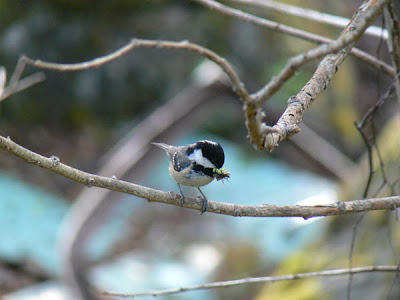

A cracking way to start a day.
As I said nest sites in this wood seemed to be at something of a premium. Most unusually in my experience this robin (beautifully snapped as a blur - it was dark in there!) was nesting in what seemed to be an old rabbit burrow in the hillside. As the chicks fledged the day I took this I never got the chance to get a better picture.


The day we arrived I saw a cuckoo nearby, and they could often be heard calling on the hill behind through the morning. It was only on the last night I realised 2 or three were coming down in the evening and feeding next to the cabin. I found somewhere I could use as a hide, but the light was going, so these were sadly the best shots I managed. If only I'd had one more day ....................


The first morning I went out about 6am, and immediately saw a treecreeper. Then another. And another. And a fourth! Turned out to be two adults feeding two young.


There were tree pipits (no photos) and I saw one spotted flycatcher, although the picture below was from a wood about 2 miles away when we were up last year.


Inevitably there were greater spotted woodpeckers, but I didn't find a nest. Again the nest shots below were from Craigellachie Nature reserve last year. This is a great little spot right on the outskirts of Aviemore. As well as the flycatchers and woodpeckers there are redstarts, and peregrines nesting on the crags above, all just a few hundred yards from several major hotels with their coachloads of tourists. Apart from the locals walking dogs hardly anyone goes there.

A rabbit used a bush right outside the cabin kitchen window to rest up in the day. It was brilliantly camouflaged - I bet you can't see it even though I can promise it's in the middle of this snap.

Mind you when it did come out you couldn't really miss it!

The vole was a Kay find and photo from the bedroom - not too bad considering it was taken with a 3x zoom pocket camera.

There were various bugs around, including the deer tick that managed to attach itself to my groin (the penalty for lying down to snap coal tits?). Thought I'd got it out, but ended up having to carry out a bit of tweezer and needle surgery two days later to remove the last bit of embedded head. Now I'm waiting to develop Lyme disease!
This rather lovely beetle posed nicely for me. At first I though it was a violet ground beetle because of the colours, but the morphology is all wrong, and I guess it is from the Dor beetle family. Anyway it too seemed to have parasites, and a few more than I did.

They looked like aphids, but I'm sure they were something more unpleasant, so maybe the hills did have scary eyes after all ..........

Friday, May 11, 2007

More local springwatching

Another weekend and this time I did go to Nagshead one morning. It was cold and dark. Typical! The redstart was singing away up in a tree, but didn't seem in any hurry to come down. The pied flycatchers were around, but the best views were 20 yards off. I saw a bird leave another nestbox and patiently waited behind a tree to catch my shot, but it turned out (eventually) to be a great tit. Still the bluebells were pretty .......

and I did find a wren's nest in good view - but dreadful light so there is a snap of the nest (which stays still), but not of the wrens (which don't).

At Parkend the nuthatches were in slightly better light for once and I caught this food pass.


Back at home Kay found a slow-worm by the pond, and so her first snap hits the blog.

The several pairs of starlings nesting under our eaves have monopolised the mealworms to the extent that each feed is gone in a few minutes, ...................


but then given the decline in their numbers I won't begrudge them that. Or the fact that all bar one of the occupied woodland nest holes I found locally turned out to contain starlings. The other? Another great tit!

The 'wild' starlings were surprisingly wary despite nests about 15 feet high, and so I didn't stay too long, but managed a few shots of feeding.
Meanwhile down at the pond recently the warm weather saw a succession of damsel flies hatching:
The nymph emerges, showing the tail 'feathers' that I always tried to copy when tying my damselfly nymph trout flies.

After a while the adult emerged to dry and swell in the sunshine

revealing another large red damsel. If you look closely there is another on the sedge leaf below and behind.

It soon joined the others on a nearby spirea. Don't know why, but they really seemed to go for this bush.

Back at the pond all the empty cases brought a warm glow at the thought that even my little pond could be such a useful resource to the local wildlife. Awww!

Wednesday, May 02, 2007

No Pain, No Gain

Last weekend I was left with a dilemma. The pied flycatchers and redstarts at Nagshead, or another go for the Hawfinch. Received wisdom was that Hawfinch may well have moved on, but their attraction still proved too great, and my hide and I ended up going back - twice.

I set the hide up nearer the spot they had shown the week before, despite the fact that it was on a 15-20 degree slope. As usual the tricky little buggers then appeared in the other spot! When they flew I turned the hide round and ....... you've guessed it; they moved and once again I was having to view them out of the little side window.

Over 2 days and about 6-7 hours of very uncomfortable balancing and twisting (cramp and 'dead legs' - couldn't use a seat) I racked up some great views, sometimes within 6-8 feet. The best time was a period of several minutes when a male was feeding a female. The female took on the pose adopted by young birds begging for food - head down and wings fluttering, and the male hopped over and passed food with great tenderness given the size of that beak. Sadly the camera was pointing out another window at the time, but I didn't want to scare them by moving it so I just enjoyed the show.

Overall there were more birds around than the week before, and there was a ticking in the trees for long periods. More extraordinary was the sound I heard once and which Chris had described the week before. A high whistle in a rising tone that sounded for all the world like a camera flashgun recharging. The light was still poor, and I ended up shooting with the aperture wide open, exposure shortened a full stop and I was still only getting a shutter speed of 1/50-60th at best. Unfortunately the Panasonic FZ30 I use is rubbish at anything higher than 200 ASA equivalent. Still in the end some pictures weren't too bad (click on the pics for bigger views). Wait until I get out with a DSLR!


The hide again allowed some great views of the local squirrels, including several youngsters. The most surprising view was the jay that hopped onto a branch 4 feet away and had a good look at me before flying on, sadly before I could get a shot (bloody camera out wrong window again!).

The level of foliage on the trees means that's probably it for pictures this year as the effort is outweighing the results, but it is reassuring to know they can be snapped with some time and patience (and good tips on feeding sites - thanks Chris).